
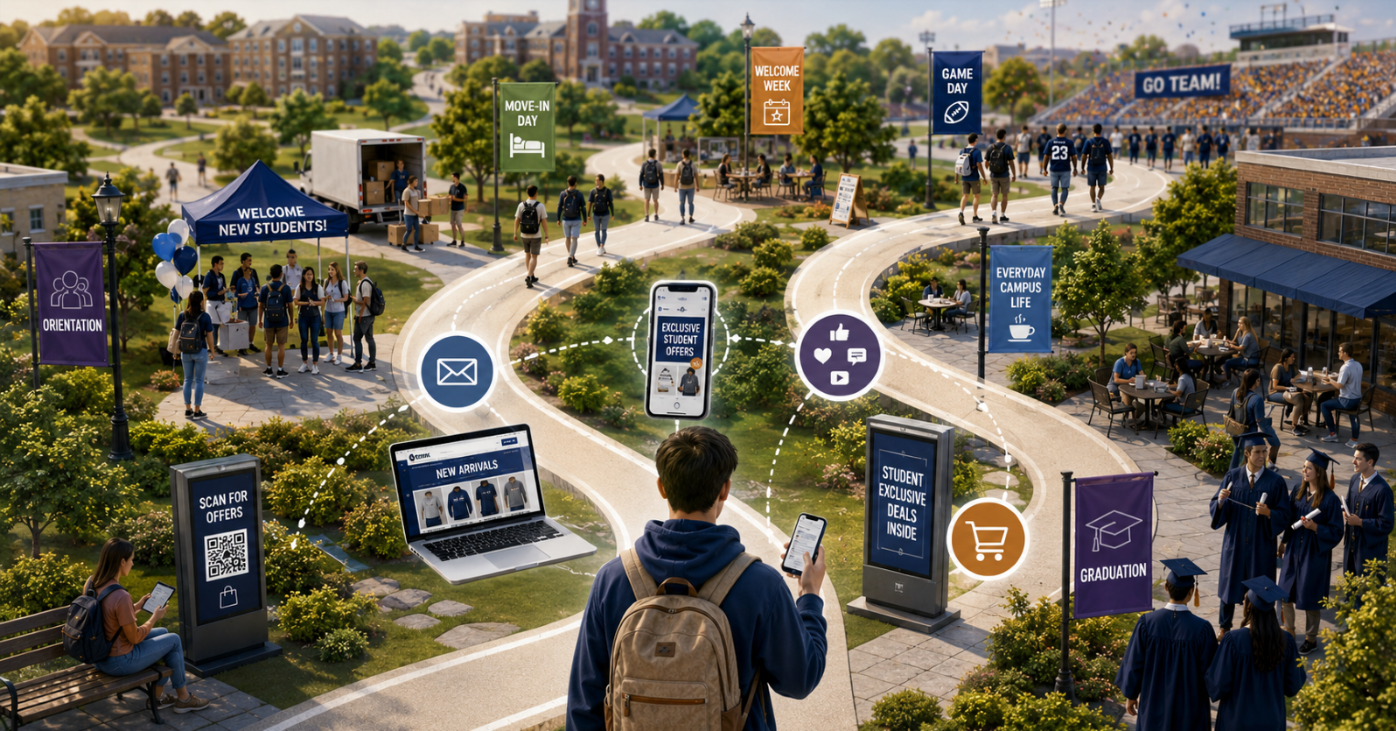
Multiple touchpoints in a trusted ecosystem
Most brands treat back-to-school as a retail window. It isn't.
By the time students arrive on campus for the first day of class, shopping lists are already taking shape. Habits are forming. Brand preferences are beginning to solidify.
The brands that show up only during move-in week are arriving after much of the work is already done. The brands that win back-to-school understand something different: this is not a moment. It's a sequence.
Students don't shop in one moment
Student purchasing behavior unfolds continuously across campus life - through orientation, move-in, welcome week, game days, and the rhythms of everyday academic experience. Each of these moments carries distinct intent. A student stocking a dorm room is not the same consumer as a student browsing between classes or picking up gear before a home game.
This matters because students are not moving through a traditional marketing funnel. They shift constantly between physical and digital touchpoints, and the brands that treat these as separate channels consistently underperform against those that connect them.
In our research conducted across campus bookstore audiences, we found student shopping behavior is nearly evenly split between in-store and omnichannel engagement, with a significant portion browsing online before completing purchases in-store. No single touchpoint drives the outcome. The impact comes from how the channels work together.
Why convenience is the real competitive advantage
Price is not where campus retail wins against Amazon or mass-market alternatives. Convenience is.
Proximity, accessibility between classes, and the ability to fulfill immediately create a purchasing environment that ecommerce cannot easily replicate.
When students are already on campus, the friction to interact with a brand drops dramatically. Students are managing packed schedules and when something they need is immediately available and directly on their path, the purchase happens - that's convenience winning on its own terms.
For brands, this is the opening. The question is whether the campaign is built to take advantage of it.
What winning campaigns actually look like
The most effective back-to-school campaigns running through campus media networks right now are not single-channel efforts. They are connected ecosystems built around how students actually move through campus life.
A global candy brand ran a two-month omnichannel campaign across more than 235 campus bookstores, combining email, in-store sampling, and social ambassador activations. The campaign distributed 250,000 product samples, achieved a 39% email open rate, and drove a 21% in-store sales lift compared to the prior year - with one product variant posting a 165% increase in sales.
A national restaurant chain used geo-targeted student email, in-store QR signage, and trackable digital offers tied to campus-proximate locations. The campaign reached over 3 million Gen Z impressions, drove more than 10,000 coupon redemptions, and returned more than 10x revenue on initial investment.
A home organization retailer activated specifically around the back-to-school dorm moment through dedicated email campaigns, in-store pop-up experiences, and targeted signage. The campaign reached 2 million students and posted a 38% average open rate with a 24% unique click-open rate.
In each case, the result was not produced by any single tactic. It came from alignment - channels working together at the moments when students were already primed to engage.
Why campus media networks are built for this
Back-to-school is one of the few periods where physical and digital engagement happen simultaneously and at scale. That is precisely why campus media networks are structurally better positioned for this moment than general media buys.
Unlike traditional channels, campus media networks operate inside the environments where students live, shop, study, and socialize. Activation is not proximate to the student experience - it is part of it. That distinction changes what's possible for a brand.
How Follett Media Network helps brands reach students across every campus moment
Follett Media Network reaches more than 6 million students across 1,000+ on-campus and digital stores. Its omnichannel ecosystem - spanning targeted email, onsite and offsite digital media, in-store signage, sampling, ambassador programs, and experiential retail - is built around the full arc of the student journey, from acceptance and orientation through athletics, graduation, and alumni engagement.
What separates FMN from fragmented media strategies is first-party student data combined with physical campus presence. Campaigns can be geo-targeted, moment-specific, and measured against real purchasing behavior - not just impressions.
The student audience is not waiting to be found in August. The brands that reach them first, and stay present longest, are the ones that convert campus presence into lasting brand preference.
Are you ready to reach the student audience?
Tell us your goals and the Follett Media Network team will put together a plan to get your brand in front of the right students, at the right moments. Get in touch →