

Are brands missing the student opportunity?
Gen Z is one of the most valuable and difficult audiences for brands to reach today. They are digitally native, highly selective, and increasingly resistant to traditional forms of advertising.
While brands invest heavily in social media and digital channels, many are overlooking a powerful and underutilized environment: the college campus.
College campuses are not just places of education. They are environments where students develop habits, form preferences, and establish long-term relationships with brands. If companies want to build meaningful connections with Gen Z, they need to start where those connections are most likely to form.
Why Gen Z is harder to reach than ever
You may already be seeing signs that reaching Gen Z is no longer as simple as increasing media spending. This audience has grown up surrounded by content, making them more skeptical of traditional advertising and more selective about what they engage with.
In our experience working with brands, we find Gen Z prefer authenticity, peer influence, and experiences that feel relevant to their lives.
At the same time, their attention is fragmented across multiple platforms and devices. This makes it harder for brands to break through using conventional approaches. Visibility alone is no longer enough. Brands need to be present in contexts where their messaging feels natural and timely.
Read more in our strategic guide for brands on winning Gen Z ->
Why Campus is one of the most powerful marketing environments
College campuses offer a unique combination of proximity, frequency, and influence that few other environments can match.
Students make frequent purchasing decisions across a wide range of categories, including apparel, food, technology, and everyday essentials. These decisions are often immediate and driven by real needs, which creates consistent opportunities for brands to engage.
Campuses also function as contained ecosystems. Students live, study, and socialize in the same environment, which allows brands to reach them in a more consistent and contextual way. Unlike fragmented digital channels, campuses provide a setting where behavior and attention are more concentrated.
Most importantly, college represents a formative stage in a person’s life. Students are gaining independence and developing preferences that often carry into adulthood. The brands they choose during this time can become part of their long-term habits.
The student journey: Key moments that drive spending
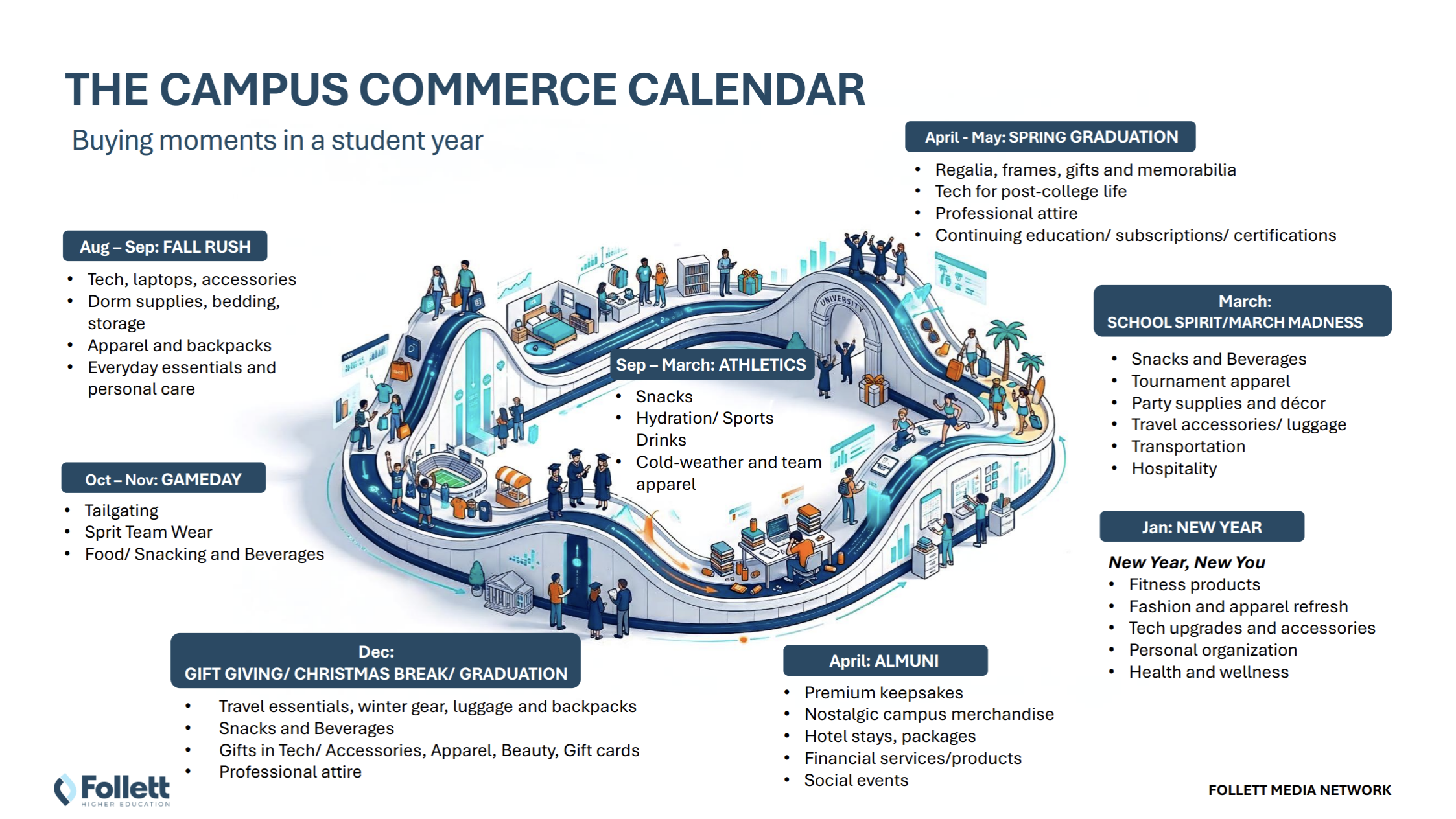
The student experience is not a single moment but a series of stages, each with its own set of behaviors and purchasing needs.
The beginning of the academic year is a critical period, as students prepare for classes and campus life. Throughout the academic journey, ongoing needs create repeat purchasing opportunities.
Campus events and athletics introduce emotional moments that can strengthen brand connections. Graduation marks a transition into a new phase of life, while the alumni stage offers continued engagement beyond campus.
Each of these moments provides an opportunity for brands to connect with students in ways that are relevant and timely.
Why omnichannel campus media works
An effective campus strategy requires more than a single touchpoint. It depends on a coordinated approach that integrates both physical and digital channels.
Digital media helps build awareness and maintain consistent engagement, while physical presence influences decisions at the point of purchase. When these channels work together, they create a more cohesive experience for the student.
Brands can engage students through targeted email campaigns, digital placements on campus bookstore websites, in-store signage, and experiential initiatives. This combination ensures that messaging is reinforced across multiple interactions.
What makes this approach effective is the alignment of proximity, context, and repetition. Students encounter brands in environments where they are already making decisions, which increases the likelihood of influence and conversion.
How brands capture student spending
Capturing student spending requires a deliberate and consistent strategy.
Successful brands focus on reaching students within their daily environments, influencing decisions at key moments, and maintaining a presence across multiple touchpoints.
Students are influenced not only by what they see, but also by where and when they see it - a brand that appears during a relevant moment, such as a purchase decision or a campus event, is far more likely to make an impact than one that relies solely on broad digital reach.
By aligning messaging with the student experience, brands can move beyond awareness and begin to influence actual behavior.
Why campus strategy drives long-term value
The impact of campus marketing extends well beyond the college years. Students who form relationships with brands during this stage often carry those preferences into adulthood.
As they transition into the workforce and gain greater purchasing power, these individuals become long-term customers. This makes early engagement especially valuable, as it can lead to sustained brand loyalty over time.
Campus strategy should not be viewed as a short-term tactic. It is an investment in long-term customer acquisition and retention.
How Follett Media Network helps brands win on campus
Follett Media Network enables brands to connect with students through a comprehensive, omnichannel approach.
With access to 6M+ students across 1,000+ on-campus and digital stores, FMN provides the scale and reach needed to engage this audience effectively. Brands can leverage email, digital media, in-store media, and experiential initiatives to connect with students at meaningful moments.
This integrated approach allows brands to move beyond awareness and drive measurable impact within the campus environment.
Winning Gen Z starts on campus
Gen Z requires a different approach from previous generations. Traditional strategies are no longer sufficient to capture their attention or influence their decisions.
Brands that succeed will be those that engage students early, in environments where their habits and preferences are formed. College campuses offer a unique opportunity to do exactly that.
Winning Gen Z is not just about visibility. It is about being present at the right moments, in the right context, with the right strategy.
Get the Campus Commerce Playbook
Despite its potential, campus marketing remains underutilized compared to other channels. This creates an opportunity for brands that are willing to invest early.
We built the Campus Commerce Playbook to provide insight into how Brands are winning Gen Z and their spending power.
The playbook gives advertisers a clear view of student life on the campus and the moments that shape how they discover, choose and buy throughout the year.
It distills campus routines, academic rhythms, and lifestyle behaviors into brand opportunities.
It shows how your message can show up naturally in the student experience with relevance and scale.